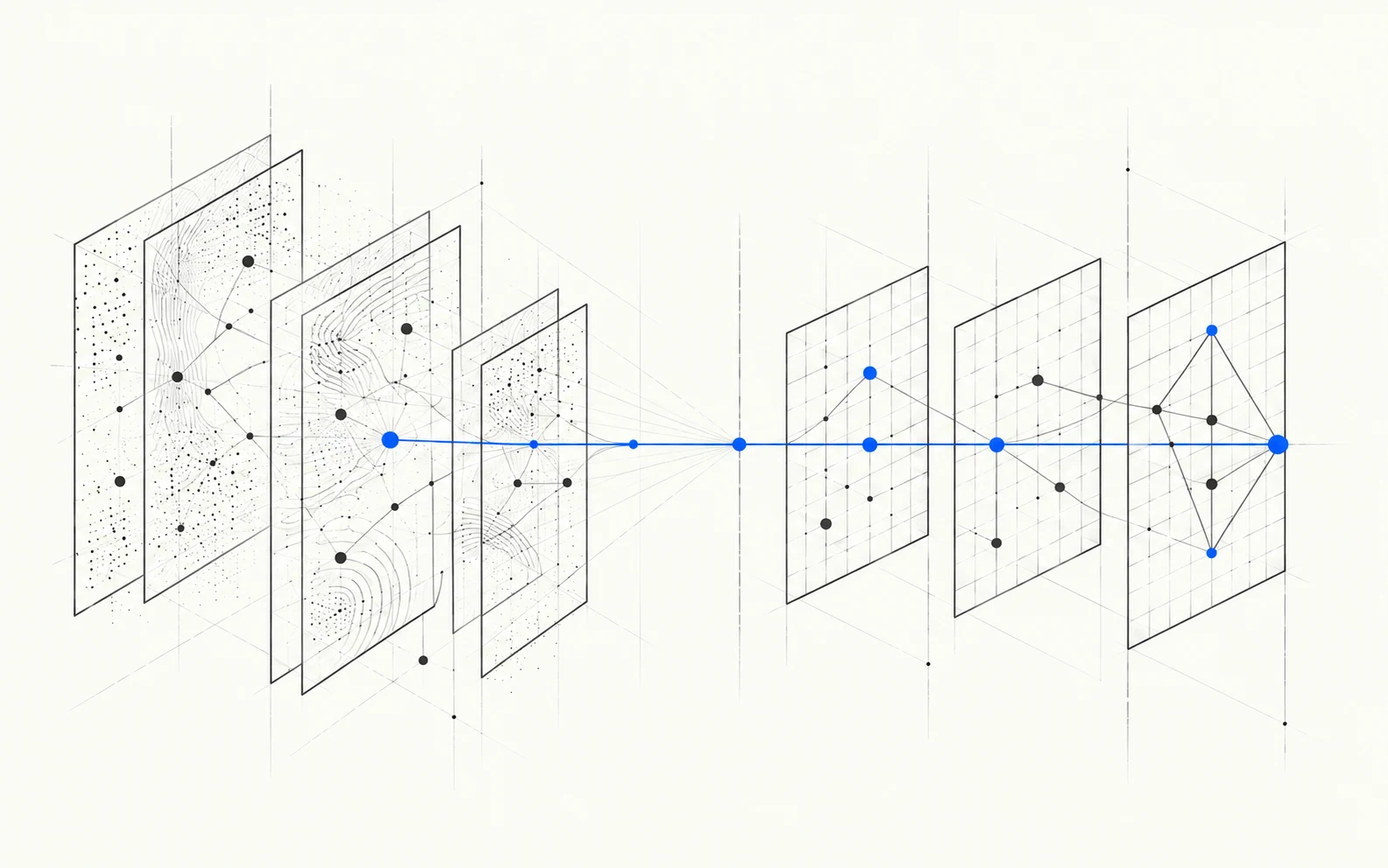
File storage is outdated. It’s a nested tangle of folders, subfolders and docs, and it’s terrible to search through. The structural problem is that the unit of storage is still the document: one file per storage slot. That’s fine to archive docs, but it’s terribly inefficient to reason about a broad problem that spans files and projects. For reasoning, the data you need to retrieve is rarely the document. It is an assumption, a forecast, a risk and the evidence behind it. Those reasoning units are buried across files, folders and projects, and to make them retrievable, we need to store them directly.
The concept of a reasoning unit is well represented across the way we work. Good presentations separate ideas one slide at a time. Documents separate themes using headers and a table of contents. A financial model is broken into grouped tables: sources & uses, income statement, returns, etc. Yet storage simply ignores the structure and collapses reasoning units into the wrong shape.
That makes our jobs harder. Take a simple example: you are a PE associate assessing growth potential for a new opportunity. You need to evaluate underlying drivers: industry growth, historical sales, customer retention, product expansion, etc. To retrieve the data, you must know which folders to open, which files matter, which pages have the evidence and how to standardize the facts. You do this across a deal folder and dataroom with 100s of files. Now imagine benchmarking that view against 10 prior deals in the same sector. At that point, your job starts to look more a librarian’s than an investor’s.
With Seaglass, we are rethinking storage to enable retrieval of reasoning units. We are starting with private investors whose workflows are particularly affected by outdated storage practices. Our product extracts investor-specific reasoning from historical deal context, standardizes it and stores it inside relational databases, where 1 row equals 1 reasoning unit.
Table storage enables query context in SQL, a language that AI agents are great at. This means highly efficient filtering, joining, aggregation, ranking and comparison of context. This functionality is core to how investors work. They benchmark metrics (filter & rank past deals → join evidence → normalize → compare). They generate comps (filter & rank past deals → group by tiers → aggregate). They deep dive into evidence (filter data → join enrichment data → compare).
This only works if the data is extracted and stored in the right shape. A reasoning row is not text you retrieve once; it is reusable context across your deal history. Stored this way, context becomes a feature set: queryable, comparable, auditable and eventually usable to build proprietary analytics for investors. RAG with vector-search, which does naive semantic search, can’t compete with this. It’s fine for simple Q&A but our approach enables true investor reasoning (benchmarking, comps, natural language querying) that leverages a firm’s historical thinking.
I spent 10 years building AI, most of it at Meta where I was Lead Data Scientist for GenAI at Instagram. AI is incredible and transformative, but the part I’m most excited about is what it can do outside chatbots. A lot of the world still runs on messy context, and there is a huge opportunity to rethink data infrastructure with AI for industries where most knowledge is C:\trapped\in\deeply\nested\files…
Tristan
Cofounder, tech & product